

Key Takeaways
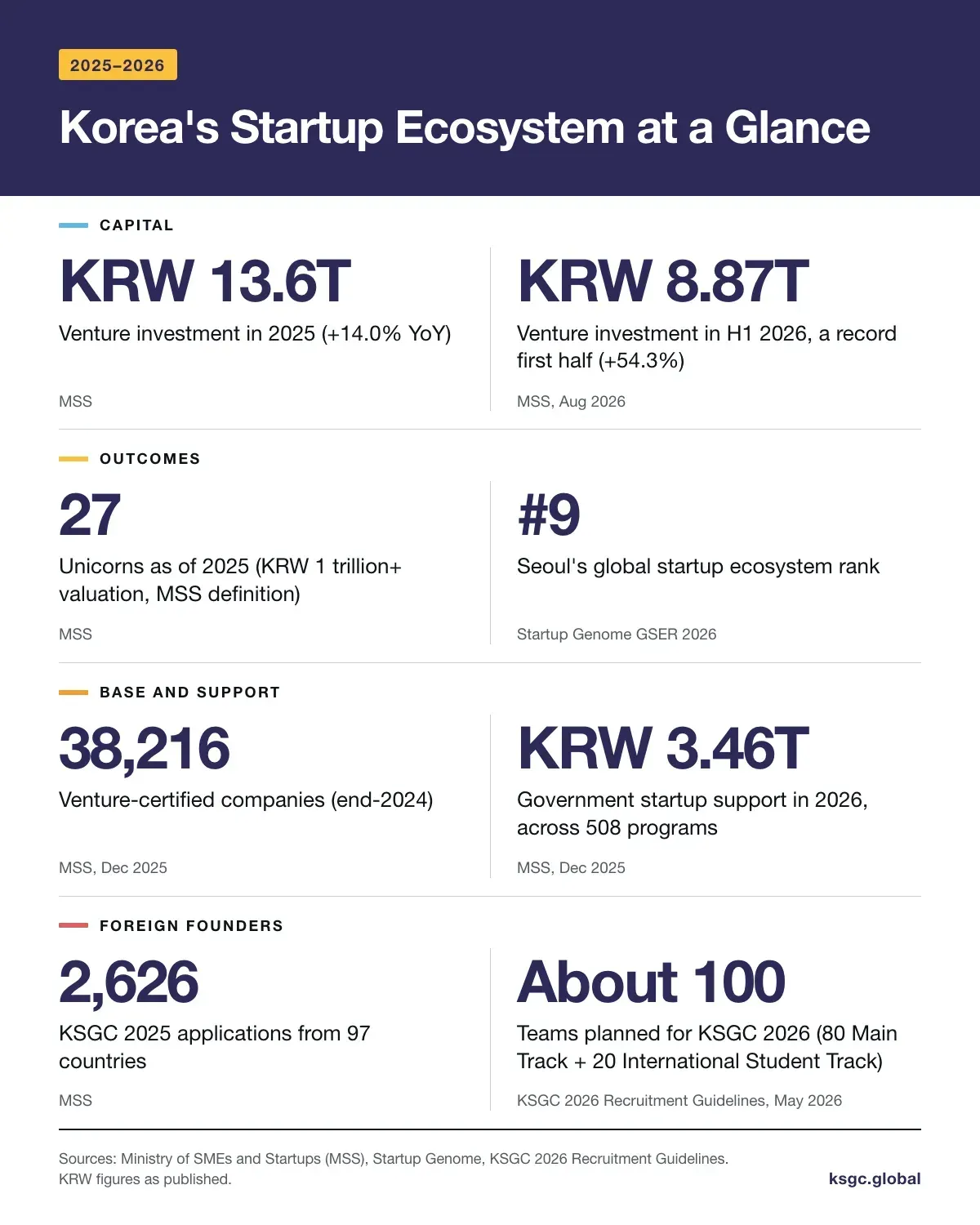
The Ministry of SMEs and Startups (MSS) reports KRW 13.6 trillion in Korean venture investment for 2025, up 14.0% from 2024.
Venture investment reached KRW 8.87 trillion in the first half of 2026, up 54.3% year on year, a first-half record (MSS).
MSS counted 27 Korean unicorns in 2025; Startup Genome counts 17 active unicorns in Seoul, using different geographic and valuation criteria.
Startup Genome's Global Startup Ecosystem Report (GSER) 2026 ranks Seoul #9 among global startup ecosystems and #3 in Asia.
According to MSS, K-Startup Grand Challenge (KSGC) received a record 2,626 applications from 97 countries in 2025.
Korean startup statistics use different currencies, reporting periods, and definitions. Below are 15 numbers to help you assess the ecosystem in late 2026. Each comes with its reporting period, source, and context.
Capital: Venture Investment Hit a First-Half Record in 2026
1. KRW 13.6 trillion invested in 2025. The Ministry of SMEs and Startups (MSS) puts new venture investment in Korea at KRW 13.6 trillion (approx. USD 9.58 billion) for 2025, up 14.0% from 2024. That makes 2025 the second-biggest year on record, behind only 2021 (KRW 15.9 trillion). The deal count, 8,542, was the highest ever.
Fundraising by venture funds grew faster still. The amount raised by new venture funds rose 34.1% to KRW 14.3 trillion in 2025, with private sources providing 80% of the total (MSS, February 2026).
2. KRW 8.87 trillion in the first half of 2026. MSS reported in August 2026 that new venture investment in the first half of 2026 reached KRW 8.87 trillion (approx. USD 5.98 billion), up 54.3% year on year. This was a first-half record, surpassing the previous high of KRW 7.64 trillion in the first half of 2022.
3. Investment in companies up to 3 years old rose 56.4%. In the first half of 2026, companies up to 3 years old raised KRW 1.83 trillion, up 56.4% year on year, according to MSS. The broader group of companies up to 7 years old, which includes those younger companies, raised KRW 4.20 trillion, up 58.0% year on year.
Location matters too. When only venture capital firms and their funds are counted (a KRW 4.53 trillion base), Gyeonggi Province, which surrounds Seoul, drew KRW 1.25 trillion in the first half of 2026, up 106.9%. MSS ties growth in the Seoul capital area to money concentrating in AI innovation clusters such as Pangyo Techno Valley in Gyeonggi. Because the regional data uses this narrower base, it won't add up to the national total.
Planning to raise here? Our guide on how to meet Korean VCs covers the practical side.
Where the Money Goes: ICT, Bio and AI
4. 21.0% went to ICT services. According to MSS, ICT services led the first half of 2026 with KRW 1.86 trillion, or 21.0% of venture investment. Electrical equipment and machinery came second (KRW 1.54 trillion, 17.3%), just ahead of bio and medical (KRW 1.50 trillion, 17.0%). Investment in ICT manufacturing jumped 143.3%, which MSS links to large deals in AI chips, memory chips and humanoid robots.
5. 19.6% went to AI models and infrastructure. According to an April 2026 MSS analysis, AI models and infrastructure drew the most investment among 12 "new industry" fields in 2025: KRW 1.34 trillion, or 19.6%. That analysis counts only venture capital firms and their funds, a KRW 6.8 trillion base. Don't apply the 19.6% share to the KRW 13.6 trillion national total.
Outcomes: Unicorns, Listings and a Global Top-10 Rank
6. 27 unicorns, by the ministry's definition. MSS counted 27 unicorns in Korea as of 2025. Its threshold is lower than the commonly used USD 1 billion threshold. Any unlisted company that has reached a valuation of KRW 1 trillion (approx. USD 0.70 billion at the 2025 average exchange rate) counts. Rebellions, FuriosaAI, B.NOW, and Galaxy Corporation joined the list in 2025. MSS puts the average time from founding to unicorn status at 7 years and 8 months.
Why 2 unicorn counts? Startup Genome's Global Startup Ecosystem Report (GSER) 2026 counts 17 active unicorns in Seoul: companies valued above USD 1 billion that have not yet exited. The MSS figure of 27 covers the whole country and uses a KRW 1 trillion threshold. They measure different things, so don't add them together or compare them directly.
7. Seoul ranks #9 in the world. Startup Genome's GSER 2026 ranks Seoul #9 among global startup ecosystems and #3 in Asia. That is 1 place below its #8 ranking in the 2025 edition, as reported by the Seoul Metropolitan Government. Startup Genome's Seoul page reports an Ecosystem Value of USD 116 billion, a median seed round of USD 900,000, and a median Series A round of USD 4.2 million for the second half of 2023 through 2025. It also reports 429 exits from 2021 to 2025 and an average software engineer salary of USD 52,400 in 2025.
8. 76 new stock listings in 2025. According to the Financial Supervisory Service (FSS), 76 companies listed on KOSPI and KOSDAQ in 2025 and raised KRW 4.5 trillion. In 2024 the figures were 77 companies and KRW 3.9 trillion. KOSDAQ accounted for most of the listings, with 69 listings and KRW 2.3 trillion. The figures include companies beyond startups and exclude special purpose acquisition companies (SPACs) and real estate investment trusts (REITs).
A Broad Base of Tech Companies
9. 38,216 venture-certified companies. An MSS survey released in December 2025 counted 38,216 venture-certified companies (벤처기업) in Korea as of end-2024. Between them they employed 828,378 people. That is more than the 746,000 regular employees of Korea's 4 largest business groups. When it's time to build a team, see our guide to hiring your first employees.
10. 123,418 technology-based business starts in the first half of 2026. According to MSS, Korea recorded 565,640 new business registrations in the first half of 2026, down 1.5% year on year. Technology-based business starts rose 14.2% to 123,418, and their share increased by 3.0 percentage points to 21.8%. The figures are based on National Tax Service business registration data. They therefore include some conversions of sole proprietorships to corporations and businesses reopening in the same industry.
Government Money and Programs
11. KRW 3.46 trillion for startup support in 2026. MSS announced in December 2025 that Korea's central and local governments budgeted KRW 3.46 trillion (approx. USD 2.34 billion) for startup support in 2026, up 5.2% from KRW 3.29 trillion in 2025. The money is spread across 508 programs at 111 institutions, 15 of them central ministries and 96 local governments. Loans and guarantees account for 41.1% of the total, technology development 25.0%, and commercialization 23.5%. This is a national total, not the amount any one company can receive.
12. TIPS plans to select 800 companies in 2026. TIPS (Tech Incubator Program for Startups) combines private investment with public funding. Private operators select startups and invest in them, and the government provides additional R&D funding. Over its first 13 years, the program supported about 4,400 companies, which raised over KRW 20 trillion in follow-on investment (MSS, December 2025). For 2026, MSS announced plans to select 800 companies for R&D funding, 100 more than in 2025. The general track offers up to KRW 800 million over 24 months, up from KRW 500 million, the first increase in 13 years (MSS, January 2026).
Item | Amount | Period | Source |
|---|---|---|---|
MSS total budget | KRW 16.5 trillion (+8.4%), original budget approved by the National Assembly | 2026 | MSS, Dec 2025 |
Government contribution to the Fund of Funds (모태펀드) | KRW 820 billion in the original budget (2025: KRW 500 billion) | 2026 | MSS, Dec 2025 |
MSS budget for 2027 | KRW 18.07 trillion; Fund of Funds KRW 1.3 trillion | 2027 government proposal | MSS, Sep 2026 |
In April 2026, a supplementary budget added KRW 1.69 trillion to MSS spending, KRW 60 billion of it for the Fund of Funds (MSS, April 2026). The 2027 figures are only the government's proposal until the National Assembly approves them. Looking further out, a December 2025 national plan from MSS and other ministries sets 3 goals: 10,000 AI and deep-tech startups by 2030, 50 unicorns and decacorns, and a venture investment market of KRW 40 trillion a year. Those are policy goals, not results.
Our overview of government support programs for foreign startups explains the funding options and eligibility requirements for foreign founders.
Numbers for Foreign Founders
13. 2,626 KSGC applications from 97 countries. According to MSS, KSGC received a record 2,626 applications from teams in 97 countries in 2025, up from 1,705 in 2024. Of the applicant teams, 42.7% were from Asia, 31.1% from Africa, 10.7% from the Americas, and 8.2% from Europe. IT and software was the largest field at 29.6%, and 61.5% of applicant companies had already raised investment.
14. About 100 teams planned for KSGC 2026. The KSGC 2026 Recruitment Guidelines (MSS Notice No. 2026-316, May 2026) set out plans to select about 100 teams: 80 in the Main Track and 20 in the International Student Track. Under the guidelines, the Main Track narrows from 80 teams in Phase-1 to 40 in Phase-2 and 20 in Phase-3. The prize pool is KRW 380 million, with KRW 100 million for first place. The program is scheduled to run from July 2026 to April 2027.
Want to join the next cohort?
Takes a minute. We'll email you the day KSGC 2027 applications open.
Beyond KSGC, the Global Startup Center in Seoul opened in July 2024 and welcomed about 7,000 visitors from about 100 countries in its first year (MSS, August 2025). The 2026 Global Startup Commercialization Support program aims to support 15 foreign-founded companies, up from 10 in the previous round. Grants average KRW 50 million and are capped at KRW 80 million (MSS, March 2026). The 2025 round received 13 applications for every available place. The call for applications, application process, and evaluation are all in English.
A media report also points to growth in technology startup visa issuance. Money Today reported in June 2026, citing Ministry of Justice and MSS data, that the number of newly issued Technology Startup Visas (D-8-4) rose from 46 in 2023 to 77 in 2024 and 104 in 2025. The same report put cumulative Startup Korea Special Visa (D-8-4S) issuances at 24 through April 2026. Before you plan a move, check which visa you need and what setting up a corporation in Korea involves.
Context: R&D Spending and How to Read These Numbers
15. 5.13% of GDP spent on R&D. According to the Ministry of Science and ICT, Korea's gross R&D spending came to KRW 131.0 trillion in 2024, up 10.1% from 2023. At 5.13% of GDP, Korea ranked second in the ministry’s international comparison, behind Israel (6.35%, based on 2023 data). Private and foreign sources provided 78.8% of the funding.
Before you quote any of the figures above, keep 3 caveats in mind.
Currency. KRW amounts are rounded for readability; dollar equivalents are calculated from the underlying unrounded figures. The conversions use KRW 1,422.22 per US dollar for 2025 and approximately KRW 1,482.88 per US dollar for 2026, the latter calculated as the mean of the Bank of Korea’s monthly average rates for January through June. These are reference conversions, not current exchange-rate quotes. Using a different exchange rate will produce different dollar amounts.
Coverage. The KRW 13.6 trillion national total combines venture capital firms, new technology business finance companies and their funds. The AI and regional breakdowns cover venture capital firms and their funds only. A share calculated on one base doesn't carry over to the other.
Market, not your odds. Budgets and investment totals describe the market as a whole, not what a single company can raise or receive.
This article is general information as of November 2026, not legal, tax, or immigration advice. Rules change; confirm with the relevant agency or a licensed professional before you act.
If you're turning these numbers into a plan, read our guides on how to meet Korean VCs and hire your first employees next.
Want to join the next cohort?
Takes a minute. We'll email you the day KSGC 2027 applications open.
FAQ
How much venture capital was invested in Korea in 2025?
According to the Ministry of SMEs and Startups, new venture investment reached KRW 13.6 trillion in 2025, up 14.0% from 2024, making 2025 the second-highest year on record.
Is venture investment in Korea growing in 2026?
Yes. Investment in the first half of 2026 reached KRW 8.87 trillion, up 54.3% year on year and a record for any first half (Ministry of SMEs and Startups, August 2026).
How many unicorns does Korea have?
The Ministry of SMEs and Startups counted 27 as of 2025, using a KRW 1 trillion valuation threshold for unlisted companies. Startup Genome's Global Startup Ecosystem Report 2026 counts 17 active unicorns in Seoul using a USD 1 billion threshold. Because the geographic coverage and valuation criteria differ, the 2 counts can't be compared directly.
Where does Seoul rank among global startup ecosystems?
Seoul ranks #9 globally and #3 in Asia in Startup Genome's Global Startup Ecosystem Report 2026.
How much does the Korean government spend on startup support?
Central and local governments budgeted KRW 3.46 trillion for startup support in 2026, across 508 programs at 111 institutions (Ministry of SMEs and Startups, December 2025).
Which sectors attract the most venture investment in Korea?
According to the Ministry of SMEs and Startups, ICT services led venture investment in the first half of 2026 with 21.0%, followed by electrical equipment and machinery (17.3%) and bio and medical (17.0%). In 2025, AI models and infrastructure drew 19.6% of investment by venture capital firms and their funds, the largest share among the 12 new-industry fields the ministry tracks.
Can foreign founders get government support in Korea?
Yes, subject to each program’s eligibility requirements and selection process. KSGC 2026 planned to select about 100 teams under its Recruitment Guidelines. MSS announced support for 15 foreign-founded companies through the 2026 Global Startup Commercialization Support program, with grants averaging KRW 50 million (March 2026).